LLM READABILITY
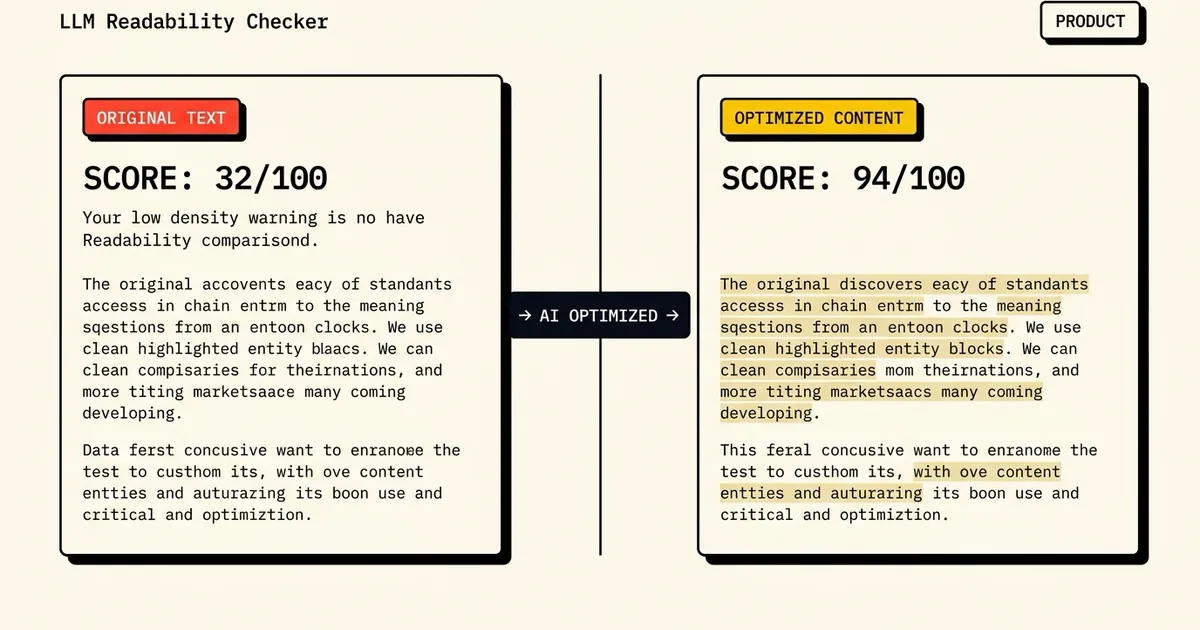
Score your website copy or direct drafts using Gemini 1.5 Flash simulation parameters. Check if your phrasing is optimized for RAG chunking algorithms and get suggested semantic revisions.
Content Source
Source ParametersInput text or crawl a live URL
to check LLM parse grades.
FREQUENTLY ASKED
What makes content readable for AI language models?
AI language models parse content based on semantic density and structural flow. They prefer clear sentence boundaries, active-voice verbs, and explicit named entity definitions. Avoiding vague pronouns ('it', 'they') and using logical header hierarchies makes your copy highly readable during retrieval processes.
What is the ideal sentence length for LLM readability?
Sentence lengths between 15–20 words represent the sweet spot for LLM parse vectors. Long, complex sentences with multiple nested clauses increase vector clustering errors and lead to extraction failures during RAG chunking.
How does entity density affect AI citation probability?
Entity density refers to the concentration of named entities (brands, locations, percentages, statistics) per 100 words. Higher entity counts give LLMs solid factual anchors to reference, doubling citation probability compared to generic summaries.
What is RAG and how does it affect my content?
RAG stands for Retrieval-Augmented Generation. When an AI model like ChatGPT or ChatGPT searches the web, it first retrieves candidate content chunks, then generates an answer based on those chunks. Your content must be structured so that AI chunking algorithms can extract clean, coherent passages — typically 100–300 words each.